
“We believe all communities should be able to address hazardous drinking water infrastructure — whether it's finding lead pipes or repairing water mains before they break — in an affordable, time-efficient manner.”
Inspired by Flint, built for communities nationwide
BlueConduit’s story began in 2016, when U‑M researchers worked with Flint’s lead service line replacement program. At the time, historical records suggested that only 10% to 20% of the city’s service lines were made of lead.
Using predictive modeling, the U‑M team found that the actual share was closer to 40%.
That insight changed how the city could approach replacement. Instead of relying only on incomplete records or digging broadly with limited information, decision-makers could prioritize homes and neighborhoods where lead service lines were most likely to be found.
The work demonstrated a powerful use of data science for good: helping communities make urgent infrastructure decisions in the face of uncertainty. Managing uncertainty for decision making is a thread that connects research spanning computer science, statistics, public health, and marketing research.
Yet this was the first case — in academic research or in practice — that machine learning models predicted the buried material of drinking water pipes. And it wouldn’t be the last.
“BlueConduit’s mission focuses on using data science and innovation to enable and empower communities to protect public health, efficiently and equitably, starting with getting the lead out,” Schwartz said.
BlueConduit was formally created in 2019 by U‑M researchers who had worked on the Flint effort. Backed by funding from U-M’s Innovation Partnerships, the company has expanded its predictive analytics tools to support water systems across the United States and Canada.
How the technology works
BlueConduit uses machine learning models to analyze data communities already have — such as historical service line records, parcel information, inspection results, and replacement data — and estimate the likelihood that a given property has a lead service line.
Those predictions help utilities decide where to inspect or dig first.
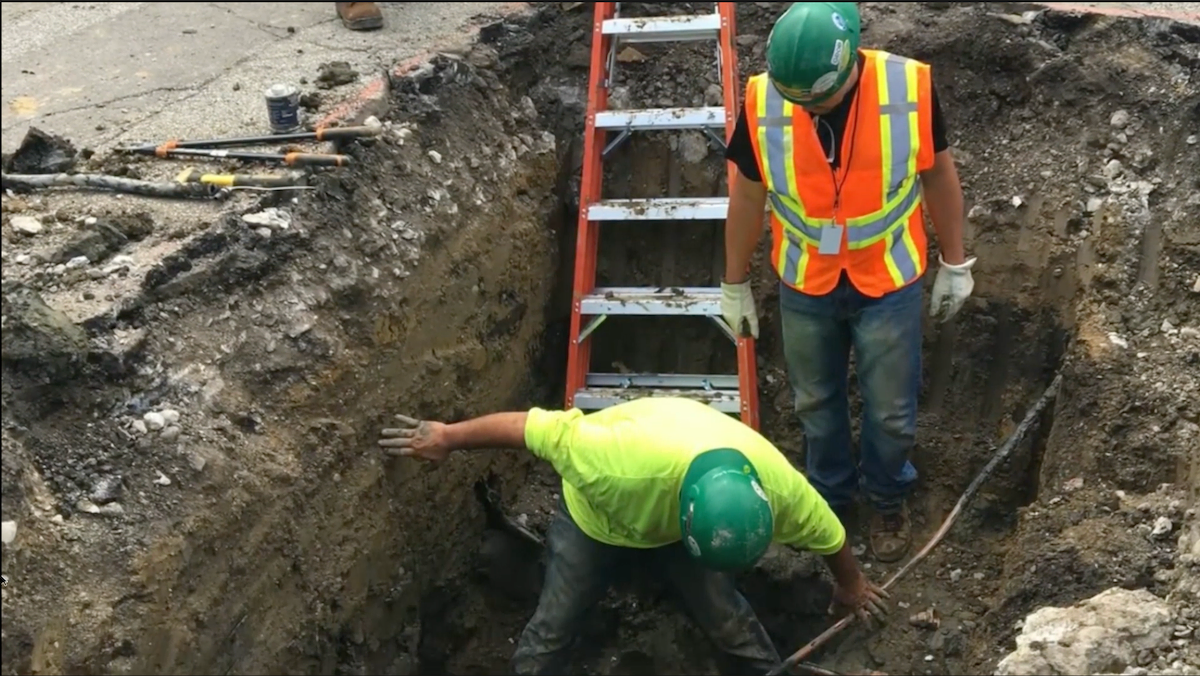
The result is a more targeted approach to lead pipe identification and replacement. Cities can reduce unnecessary excavations, focus resources on the highest-risk locations, and move more quickly toward full lead service line removal.
A national public health challenge
Lead service lines remain a widespread hazard across the country. Millions of homes in the United States may still receive drinking water through pipes that contain lead, but many communities do not know exactly where those lines are located.
That uncertainty makes replacement difficult, expensive, and slow.
“It’s estimated there are 6-12 million lead pipes carrying water to millions of people, but finding exactly where the lead pipes are has been a massive challenge,” Schwartz said. “It can take cities years to find and replace them, costing tens of millions of dollars.”
BlueConduit’s predictive approach helps reduce that burden. By identifying the areas with the highest probability of lead pipes, the company enables utilities to act faster and spend public dollars more effectively.
For customers that have already begun replacements, BlueConduit has reported a greater than 90% hit rate, meaning its lead-likelihood predictions were confirmed with more than 90% ground-truth success.
The company’s models also routinely achieve 80% to 90% or higher recall and precision in identifying lead service lines. BlueConduit says its customers spend 90% to 95% less on service line material identification compared with traditional approaches. Beyond identifying where the lead is, BlueConduit helps cities manage the process of choosing where to dig next based on many other factors, including the presence of children and other vulnerable populations, whether they serve water to child care or medical facilities, how many other lead pipes are expected on that street, and whether the water main providing water to the street is at risk of breaking.
Recognition and national impact
In 2021, BlueConduit was named one of TIME’s Best Inventions in the sustainability category, recognizing its predictive modeling technology and its potential to help communities reduce lead exposure more efficiently.
The company’s work has supported communities including Flint, Toledo, Trenton, Detroit, Des Moines, and many others. Its reach has continued to grow: BlueConduit has inventoried 6.6 million service lines in more than 350 communities in the United States and Canada, serving more than 21 million people.
BlueConduit’s work has also become part of a broader national effort to remove lead from drinking water systems. After the Environmental Protection Agency’s 2021 Lead and Copper Rule revisions required U.S. water systems to develop lead service line inventories, the EPA named BlueConduit’s work and predictive modeling in its guidance for how cities should perform inventories of their service lines. This work has had an influence at the state level as well, as it has been adopted by environmental agencies across the country in their guidance.
In 2023, BlueConduit joined the EPA’s Get the Lead Out Partnership, a federal initiative aimed at accelerating the replacement of lead service lines across the country within a decade.
“This partnership is a crucial step in combating lead exposure in our country, multiplying our combined efforts to exponentially reduce the number of days families live with the risk,” Schwartz said.
Why it matters
Lead exposure can have serious and lasting health effects, especially for children. Removing lead service lines is one of the most direct ways to reduce that risk — but communities need accurate information to know where to begin and to guide decision making over the coming years.
BlueConduit’s work shows how university research can become practical technology with real-world public health impact. What began as a response to a crisis in Flint has grown into a scalable tool for utilities nationwide.
By combining U‑M data science, machine learning, and a mission-driven commitment to public health, BlueConduit is helping communities answer a critical question: Where should we dig next? For families living with the risk of lead exposure, answering that question faster can make all the difference.